

Quick Summary
InvITs, or Infrastructure Investment Trusts are SEBI-regulated trusts that pool investor money into operational infrastructure assets like highways, power lines and gas pipelines and pass on most of the income these assets earn back to investors. This article covers what InvITs are, how they work, their benefits, how to invest in them and how they’re taxed.
Introduction
Think about the highway you drove on last weekend, the power line that keeps your lights on, or the telecom tower that gives your phone signal. Someone owns and operates all of that infrastructure and until a few years ago, only large institutions and governments could really invest in it.
That changed with the introduction of InvITs in India. They opened up a way for regular investors to put money into the country’s infrastructure and earn a share of the income it generates, without needing crores of rupees or any technical know-how about running a highway or a power grid.
What Are InvITs
An InvIT (Infrastructure Investment Trust) is a trust registered with SEBI that collects money from investors and uses it to buy and operate infrastructure assets that are already generating income. Instead of owning a road or a power line yourself, you buy units of the trust, similar to buying units of a mutual fund or shares of a company.
Some common assets that InvITs invest in include:
- National and state highways
- Power transmission lines
- Renewable energy projects
- Telecom towers
- Gas pipelines
- Operational power plants
Because InvITs are listed on stock exchanges, you can buy or sell your units any time the market is open, and there’s no lock-in period holding your money hostage.
Types of InvITs in India
InvITs in India fall into two broad categories, depending on who they’re built for.
Publicly Listed InvITs: These are listed on the stock exchange and open to anyone with a demat account, including retail investors like you and me.
Privately Placed InvITs: These are meant for institutional investors and high-net-worth individuals and aren’t available to the general public.
As of 2026, India has close to 28 InvIT trusts operating across both these categories, spanning sectors from roads to renewable energy.
How InvITs Work
Every InvIT runs on a fairly simple structure involving four parties:
- Sponsor: The entity that sets up the trust and transfers its infrastructure assets into it.
- Trustee: Holds these assets on behalf of unit holders and looks out for investor interests.
- Investment Manager: Handles the trust’s overall investment and financial decisions.
- Project Manager: Manages the day-to-day operations, maintenance and management of the infrastructure.
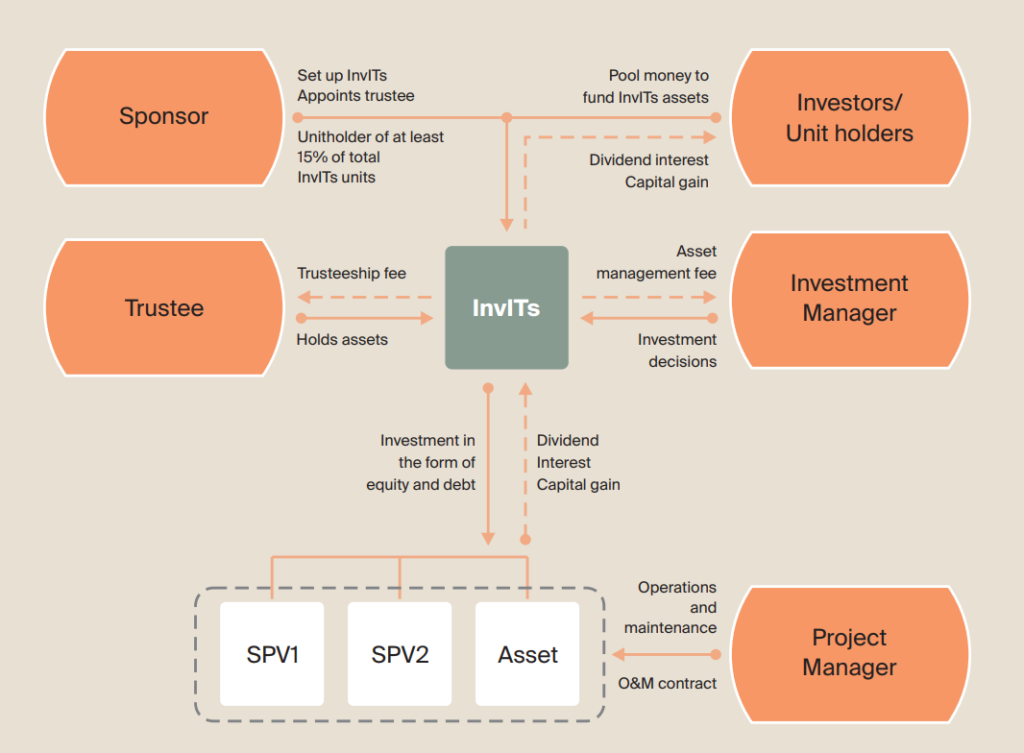
Here’s how your money actually moves through this system:
Step 1: You buy units of the InvIT, either during its IPO or later from the stock exchange.
Step 2: The trust uses this pooled money to invest in infrastructure assets, either directly or through special purpose vehicles (SPVs) set up for each project. Most of this goes into completed, revenue-generating projects, though InvITs can also hold a smaller portion in under-construction projects, government securities or liquid funds.
Step 3: The assets generate revenue, and a large chunk of it flows back to you as a unit holder, in the form of interest, dividends or return of capital.
How Returns Are Generated
InvITs typically earn money through:
- Toll collections from highways
- Transmission charges from power lines
- Lease rentals from telecom towers or industrial assets
- Usage fees for gas or electricity
- Long-term contracts with government bodies or corporations
Since these income sources tend to be fairly predictable, InvITs are often seen as income-generating investments rather than purely growth-oriented ones. SEBI requires InvITs to pass on at least 90% of their net distributable cash flow to unit holders, which is a big part of why they’re attractive to investors looking for regular payouts. This pass-through structure is similar to how REITs distribute rental income from commercial real estate, just applied to infrastructure assets instead.
Benefits of Investing in InvITs
Lower entry barrier: You can start investing with roughly ₹10,000 to ₹15,000 and the trading lot is just one unit. Before 2021, this minimum was closer to ₹1 lakh, so InvITs have become far more accessible in recent years.
Exposure to infrastructure: You get to participate in sectors like transportation, energy and utilities without having to buy or manage any physical asset yourself.
Regular income potential: Because of the 90% payout mandate, InvITs work well for investors who want a steady income stream rather than just capital appreciation.
Portfolio diversification: InvITs give you exposure to an asset class that doesn’t move exactly like equities, bonds or mutual funds, which can help balance out your overall portfolio.
Liquidity: Since they’re listed on stock exchanges, you can buy or sell units during market hours, unlike physical infrastructure investments that would take months to exit.
How to Invest in InvITs in India
Getting started with InvITs isn’t very different from investing in stocks. Here’s the process:
Step 1: Open a demat and trading account. InvIT units are held electronically, so you’ll need this before you can invest.
Step 2: Decide how you want to invest. You can either apply during a new InvIT’s IPO or FPO or simply buy already listed units from the stock exchange.
Step 3: Apply through ASBA or UPI. During a public issue, your bid amount stays blocked in your bank account through the ASBA process until units are allotted. Retail investors can also apply using UPI, within the applicable limits.
Step 4: Enter your details carefully. Make sure your PAN, DP ID, client ID and bank details are all correct, since errors here can lead to your application getting rejected.
Step 5: Track your allotment. Once units are allotted, they show up in your demat account and from there, they trade on the exchange just like any listed stock.
Before putting money in, it’s worth looking at the distribution yield, the quality and diversity of the underlying assets and the credibility of the sponsor behind the trust.
Taxation of InvITs in India
How your InvIT returns get taxed depends on the type of income you receive:
| Nature of Distribution | Tax Treatment |
| Interest Income | Taxable in the hands of the investor |
| Dividend Income | Exempt if the SPV hasn’t opted for the lower corporate tax regime; taxable if it has |
| Revenue from Underlying Infrastructure Assets | Taxable |
Since the tax treatment can vary depending on how a particular InvIT and its SPVs are structured, it’s a good idea to check the trust’s disclosures or speak with a tax advisor before assuming how your payouts will be taxed.
Conclusion
InvITs give everyday investors a genuine way to participate in India’s infrastructure growth story, whether that’s highways, power grids or renewable energy, without needing the kind of capital that was once required to invest in these sectors directly. They offer a mix of regular income, reasonable entry points and liquidity that’s hard to find elsewhere in this space.
That said, InvITs aren’t a substitute for fixed deposits or guaranteed-return products. Their returns are linked to how well the underlying assets perform, so it’s worth understanding the trust, its assets and its track record before you invest. Used thoughtfully, they can be a useful addition to a well-diversified portfolio.
Disclaimer: This article is for informational purposes only and does not constitute investment advice. Investments in securities are subject to market risks. Investors should consult a registered financial advisor before making any investment decisions.