

For over two years, Tata Sons has been trying to find a legal way out of going public. That attempt just failed. On September 11, 2026, the Reserve Bank of India turned down its request to exit a regulatory category that would have let it dodge a mandatory stock market listing.
If you have not been following this story closely, here is why it matters. Tata Sons is the holding company sitting on top of the entire Tata Group, the entity that owns controlling stakes in Tata Motors, Tata Steel, Tata Consultancy Services, Tata Power and a dozen other listed Tata companies. It has never been listed itself. With this rejection, that could be about to change and if it does, it may end up being one of the largest IPOs India has ever seen.
What is Tata Sons and Why Does This Rule Apply to It
Think of Tata Sons as the umbrella company that holds the shares of every major Tata business. It does not sell cars or steel or software itself. It just owns large stakes in the companies that do, and it earns income mainly through dividends from them.
Because it functions this way, the Reserve Bank of India classifies it as a Core Investment Company, or CIC. In simple terms, a CIC is a company whose main business is holding investments in other group companies rather than lending to the public or taking deposits.
In September 2022, RBI placed Tata Sons in a stricter bracket called the ‘Upper Layer NBFC’ category, reserved for the largest and most systemically important finance companies in the country. Any company that falls into this bracket is required to list on the stock exchange within three years. For Tata Sons, that gave it a deadline of September 2025.
Tata Sons’ Attempt to Avoid Listing
Tata Sons was not keen on going public. A listing brings far more disclosure requirements, quarterly scrutiny, and public shareholder pressure, all things a privately held family-controlled company had managed to avoid for over a century.
So in March 2024, after paying off its outstanding debt, Tata Sons applied to RBI to voluntarily give up its CIC registration. Its reasoning was fairly simple: if it no longer carries debt or behaves like a typical NBFC, it should not have to follow NBFC listing rules either.
That application then sat with RBI for close to two years. No approval, no rejection, just silence, even as the original listing deadline of September 2025 quietly passed without any resolution.
The Shareholder Tug of War
While all this was pending, the two big shareholders of Tata Sons were not on the same page.
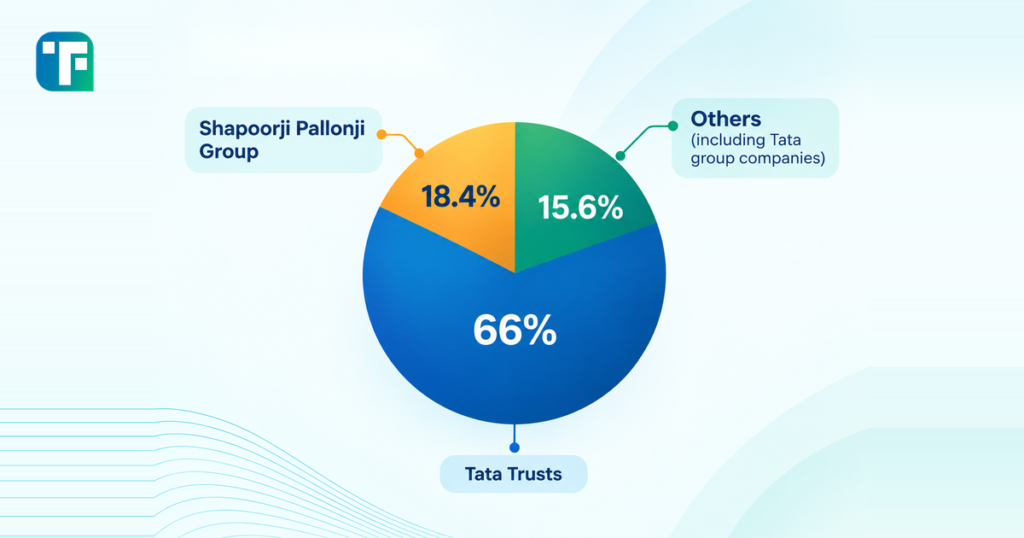
- Tata Trusts, which owns about 66 percent of Tata Sons, did not want a listing. Going public would mean diluting its grip over how the entire Tata Group is run.
- The Shapoorji Pallonji Group, which holds close to 18 percent, actually wanted the listing. The group has faced its own financial pressure and saw a public listing as a way to unlock value from its stake.
This disagreement is part of why RBI’s decision carried so much weight. Whichever way it went, one shareholder was always going to come out ahead of the other.
What Happened on September 11, 2026
RBI finally responded and it rejected Tata Sons’ request to exit the CIC category.
The reasoning came down to numbers. To qualify for this kind of exemption, a company needs to hold no public funds, have no direct customer interface and have total assets under ₹1,000 crore. Tata Sons reported total assets of ₹2.01 lakh crore as of March 2026, more than 200 times higher than that limit. There was simply no way to argue it fit the exemption criteria.
What this rejection actually does is shut down the one legal escape route Tata Sons had been pursuing since 2024. What it does not do is set a brand new fixed deadline. RBI has told Tata Sons to move toward listing but there is no publicly confirmed date by which this needs to happen.
What Happens Next
Tata Sons still has a few cards left to play. Reports suggest it may explore restructuring its business, trimming down its asset base or even splitting the company so that a smaller entity falls below the threshold that triggers mandatory listing.
There is also a leadership question hanging over all of this. Chairman N Chandrasekaran has told the board he will not seek a third term when his tenure ends in February 2027, following reported disagreements within the board. Whoever takes over next will likely have a major say in how Tata Sons finally responds to this pressure.
So while the pressure to list has clearly gone up, the actual timeline is still an open question.
Why This Matters for Investors
Even without a confirmed date, this is a story worth watching closely for a few reasons.
Analysts have floated valuation estimates for Tata Sons in the range of $96 billion, which would put it among the largest listings in Indian stock market history if it goes ahead.
A public listing would also force far more transparency into how capital moves across the Tata Group, since listed companies face stricter disclosure norms than private holding companies ever do.
If a Draft Red Herring Prospectus does eventually get filed, retail investors should approach it the same way they would any other IPO. A big brand name is not a substitute for due diligence, so it is worth revisiting some of the common IPO mistakes investors should avoid before applying to any large offering, Tata Sons included.
Conclusion
RBI has taken away the one legal path Tata Sons had to remain private. That does not mean an IPO is landing next month, but it does make one far more likely somewhere down the line. For now, investors have one less reason to doubt that India’s most valuable private conglomerate will eventually have to answer to public shareholders.
A high-profile name and a large valuation do not always translate into strong listing gains, as seen in cases where the grey market premium ends up far ahead of the actual listing price. Worth keeping in mind if a Tata Sons IPO does eventually hit the market.
This article is for informational and educational purposes only and should not be considered investment advice. Please consult an investment advisor before making any investment decisions.