

Mega IPOs always arrive with high expectations. There is media coverage, grey market chatter and long queues of retail investors trying to grab an allotment before the stock even lists. It feels like everyone wants in, and the opportunity seems almost guaranteed.
But when you look at how some of India’s largest and most talked-about IPOs performed after listing, a very different picture emerges. Strong hype at launch was followed by a sharp fall within a year of listing. This article walks through ten of these IPOs, what the data actually says, and what it means for anyone deciding whether to apply for the next big issue.
Why Hype Builds Around Mega IPOs
Before getting to the numbers, it helps to understand why these IPOs attract so much attention in the first place.
- Large issue size: A company raising thousands of crores automatically becomes a talking point, simply because of scale.
- Brand recognition: Names like LIC, Paytm, and Zomato are already part of everyday life for most Indians, so the IPO feels familiar even to first-time investors.
- Grey market premium (GMP) chatter: Unofficial GMP numbers circulate in the days before listing, and a high GMP is often read as a guarantee of listing gains, even though it is not.
- Media coverage: Business news channels and financial portals cover mega IPOs extensively, which adds to the sense that this is an opportunity nobody wants to miss.
- Retail FOMO: Once an IPO gets heavily oversubscribed, many investors apply simply because everyone else is applying, not because they have studied the business.
We’ve covered this pattern of relying on hype instead of fundamentals in detail before, including common mistakes like treating GMP as a decision-making tool or applying purely because of high subscription numbers. If you have not read that piece yet, it is worth going through before your next IPO application.
The Data: 10 Mega IPOs, One Pattern
Here is how ten of India’s biggest IPOs performed against their issue price, both within a year of listing and at their lowest point since.
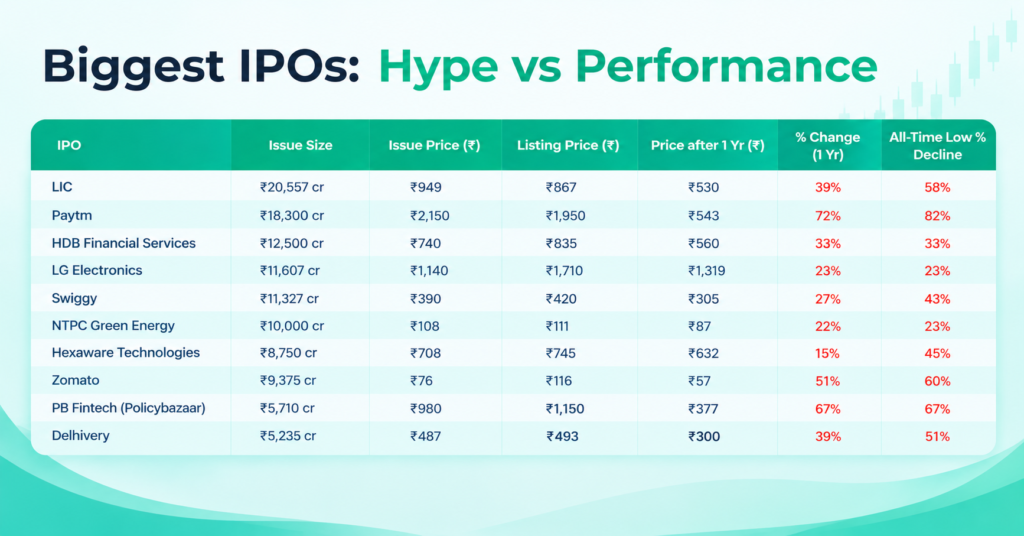
A closer look at each of these tells its own story.
LIC raised around ₹20,557 crore, making it one of the largest IPOs in Indian history. It listed at ₹867, already below its issue price of ₹949. Within a year, it had fallen to around ₹530, a decline of nearly 39% from the listing price. At its lowest point, the stock was down more than 58% from where it listed.
Paytm’s fall was the sharpest on this list. It listed at ₹1,950, and within a year had crashed to around ₹543, a drop of over 72%. Its all-time low took the decline past 82% from the listing price.
HDB Financial Services listed at ₹835. Within a year, it was trading around ₹560, down nearly 33% from listing, and that level also turned out to be its all-time low so far.
LG Electronics India listed at ₹1,710. A year later, it had slipped to around ₹1,319, a decline of roughly 23%, again matching its lowest point.
Swiggy listed at ₹420. Within a year, it had fallen to around ₹305, down over 27%. Its low went even deeper later, at nearly 43% below listing.
NTPC Green Energy listed at ₹111.5 and fell to around ₹87 within a year, a decline of close to 22%.
Hexaware Technologies listed at ₹745.5. Within a year, it dropped to around ₹632, down about 15%. But its all-time low went much further, a fall of nearly 45% from listing.
Zomato listed at ₹116. Within a year, it had fallen to around ₹57, a decline of over 51%. Its all-time low was close to 60% below its listing price.
PB Fintech (Policybazaar) listed at ₹1,150 and fell to around ₹377 within a year, a drop of over 67%, which also marked its all-time low.
Delhivery listed at ₹493. Within a year, it had declined to around ₹300, down nearly 39%. Its all-time low went further still, down 51% from listing.
What the Numbers Show
Looking at all ten together, a few patterns stand out.
- The average one-year decline across these ten IPOs works out to roughly 39%, and even the smallest fall on this list, Hexaware at -15.3%, is still a meaningful loss for anyone who bought expecting quick gains.
- For four of these companies, the one-year low and the all-time low were the same number: HDB Financial Services, LG Electronics India, NTPC Green Energy, and PB Fintech. For these, the damage was largely done within the first year.
- For the other six, the real bottom came later than the one-year mark. Swiggy’s deepest fall was 42.7% versus 27.3% at one year. Hexaware’s all-time low of -44.8% was nearly three times worse than its one-year number. The same pattern shows up with Paytm, Zomato, Delhivery, and LIC, where the worst was still ahead even after the first year had already looked painful.
- Issue size did not protect anyone. LIC and Paytm were the two largest issues on this list, raising ₹20,557 crore and ₹18,300 crore respectively, and they also recorded two of the steepest declines. A big, well-known IPO is not automatically a safer one.
Why This Happens
There are a few reasons this pattern repeats itself across mega IPOs.
- Overvaluation driven by demand, not fundamentals: When an issue is priced based on how much hype it can generate rather than what the underlying business can support, the price often has nowhere to go but down once the excitement fades.
- Anchoring to GMP instead of the business: A high grey market premium reflects short-term sentiment among a small group of traders. It says nothing about revenue growth, profitability, or competitive position, which is what actually drives a stock’s price over time.
- Lock-in expiry and profit booking: Once the lock-in period for anchor investors and early shareholders ends, a wave of selling can hit the stock, adding further pressure on the price.
- Sector-specific and broader market pressures: Fintech names like Paytm and PB Fintech faced sector-wide re-rating pressure. Companies like Delhivery were affected by competitive intensity in logistics. Broader market cycles also played a role in how deep and how long these falls lasted.
Key Takeaway for Investors
The lesson from these ten IPOs is fairly simple, hype and scale at the time of listing are not indicators of long-term performance. A company raising a record amount of money or generating enormous media buzz, is not the same as a company priced fairly for what it is actually worth.
A few practical takeaways follow from this:
- Evaluate the business and its fundamentals rather than relying on GMP or subscription numbers.
- Avoid chasing listing-day price pops, since these often reflect short-term sentiment rather than long-term value.
- Keep an eye on lock-in expiry dates, since these can trigger fresh volatility months after listing.
- Give any investment enough time and perspective before judging whether it was a good or bad decision, since even the one-year mark did not represent the real bottom for several of these stocks.
Conclusion
Ten of India’s biggest IPOs share one consistent pattern; strong hype before listing, followed by a sharp fall within a year of listing, and in several cases, an even deeper fall after that. Before applying for the next big IPO, it is worth remembering that size and buzz at listing offer limited insight into where a stock will actually be a year or several years down the line.
Disclaimer: This article is for informational and educational purposes only and should not be construed as investment advice. Please consult a registered financial advisor and review all relevant offer documents before making any investment decisions. Past performance is not indicative of future results.