

India buys most of its oil from other countries, so a change in global prices quickly shows up in our fuel bills. The Samudra Manthan scheme is the government’s attempt to reduce that dependence by searching for oil and gas under India’s own waters.
Here are the headline numbers:
- ₹84,084 crore total outlay
- 60 deepwater exploration wells
- Government support of up to 50% of the drilling cost of each well
The topic matters for two reasons. First, India’s oil import bill and its exposure to global shocks affect inflation, the rupee and growth. Second, the scheme is designed to build an offshore industry around exploration, which is of interest to long-term investors.
In this article, we cover:
- What the scheme is and how it started
- Why India needs it
- How the money will be used and what the targets are
- The wider ocean economy and the industries that may benefit
- The risks to keep in mind
What exactly is “Samudra Manthan”?
The name comes from a mythological tale in which gods and demons churned the ocean to bring out hidden treasures. The modern version is more technical but the idea is similar. India wants to search its seas for oil and gas reserves that can support a growing economy.
Key facts:
- The Union Cabinet approved the scheme on 31 July 2026
- It is a Central Sector Scheme of the Ministry of Petroleum and Natural Gas, formally called the National Offshore Exploration Scheme
- The first phase runs through FY 2030-31
In simple terms, this deep water exploration mission moves the government from announcing reforms to funding actual exploration.
Why India Needs It: The Import Dependence Problem
India imports around 88-89% of its crude oil and roughly half of its natural gas. This high India oil import dependence means the country has very little control over what it pays for energy.
When something goes wrong in the world, the effect travels in a clear order:
- A war, a sanction or a shipping disruption pushes global oil prices up
- India’s fuel import bill rises
- Higher fuel costs feed into inflation
- A larger import bill puts pressure on the rupee and the current account
- Growth slows when costs stay high for long
Producing more oil and gas at home does not remove this risk completely. It does reduce how much of the risk India carries.
How the ₹84,084 Crore Will Be Used
The outlay is divided across four main components.
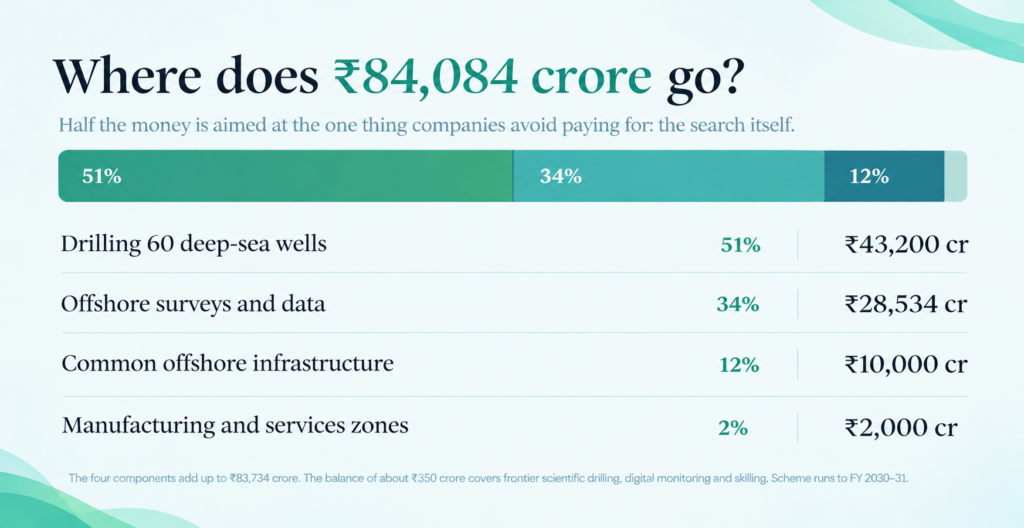
According to the government’s release, about ₹28,534 crore is set aside for seismic data and ₹43,200 crore for drilling the 60 wells.
The seismic data is an important part of the plan. Drilling in the deep sea is very costly, and better seabed data lowers the chance of drilling in the wrong place.
What Does the Scheme Aim to Achieve?
The figures below come from the government and independent estimates of the scheme.
| Target | What is expected |
| Reserves | More than 600 MMTOE (million metric tonnes of oil equivalent) added over time |
| Annual production | 10-15 MMTOE a year, with a peak potential of around 20 MMTOE if discoveries succeed |
| Import reduction | Roughly 3-5% lower oil and gas imports once production ramps up |
| Timeline | Phase I runs to FY 2030-31 |
A few points to keep in mind about these numbers:
- The scheme will reduce India’s dependence on imports, but it will not make India self-sufficient
- The reserve figure is a target, not oil that has already been found
- Even a small cut in imports can ease pressure on the rupee and inflation during global shocks
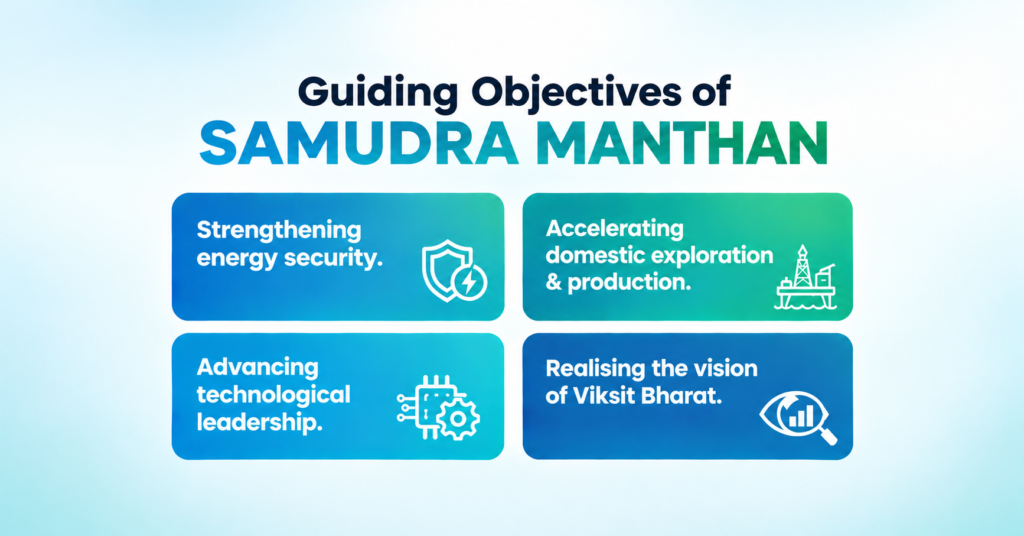
Source: Ministry of Petroleum and Natural Gas
Why the Government Is Taking on Exploration Risk
Deepwater exploration is expensive, and success is never certain. For this reason, companies have often preferred to develop fields they already know instead of searching for new ones.
The Samudra Manthan scheme changes this by sharing the cost of the riskiest step, which is drilling the exploration well.
- A company that drills a well under the scheme carries only part of the cost if the well comes up dry
- Public sector and private explorers both get a stronger reason to look at frontier areas
- Earlier reforms support this, including opening more than one million sq km of India’s Exclusive Economic Zone for exploration and moving to revenue sharing contracts
Lower risk does not guarantee discoveries. It does make it easier for a company to say yes to a difficult project.
The Bigger Picture: India’s Ocean Economy
The scheme goes beyond just oil. India has a coastline of about 11,098 km, including its islands. Beyond it lies an Exclusive Economic Zone of over 2 million sq km, the 18th largest in the world. Under the UN Convention on the Law of the Sea, India has exclusive rights to explore and use the resources within 200 nautical miles of its coast.
Other resources in this zone include:
- About 70 GW of offshore wind potential off Gujarat and Tamil Nadu
- An estimated 380 million tonnes of polymetallic nodules in the Central Indian Ocean Basin, which contain nickel, copper, cobalt and manganese
- Fisheries that support the livelihoods of crores of people
India does not yet have offshore industries at this scale. They cannot grow without steady offshore activity to support them. 60 funded wells over five years is likely the first reliable order book this ecosystem has been offered.
Which Industries Could Benefit
If the scheme moves ahead as planned, work could flow to several parts of the economy:
- Offshore drilling and oilfield services
- Engineering and fabrication
- Shipbuilding and marine logistics
- Subsea equipment and domestic manufacturing
This is a view of themes and not a list of companies to buy. Deepwater work needs specialised vessels, rigs and equipment, and India currently imports much of it. The manufacturing and services zones in the scheme aim to change that over time.
TejiFactor has earlier looked at how India’s Hormuz exposure, freight costs and shipbuilding policy connect, and you can read that in our analysis of oil and shipbuilding.
Risks and Challenges
The plan is promising, but there are real risks to watch:
- Not every well will strike oil or gas. Some of the 60 wells will come up dry or prove commercially weak. This is how frontier exploration normally works.
- The gap from discovery to production is long. After a find, approvals, engineering and construction can take years, so this is not a quick fix for petrol and diesel prices.
- Environmental and ESG concerns are real. Deep-sea drilling carries spill and ecosystem risks, and global investors increasingly review fossil fuel projects closely. India will need strong safeguards and a clear explanation of how offshore output fits with its clean energy plans.
- Execution and policy continuity matter. A scheme that runs for five years depends on timely approvals, steady funding and consistent policy from year to year.
Conclusion
The Samudra Manthan scheme will not turn India into a major oil exporter, and early targets are modest. A cut of 3-5% in oil and gas imports is meaningful, but it is not a complete change in India’s energy position.
The larger opportunity is the ecosystem the mission could build. If exploration succeeds, the benefits could extend to offshore engineering, shipbuilding, marine logistics, subsea infrastructure and domestic manufacturing over the next decade.
If you follow themes like this, you can explore more sector stories on the TejiFactor Equity Themes page.
This article is for information purposes only and should not be construed as investment advice. Investments in securities markets are subject to market risks. Read all related documents carefully before investing.
This analysis is for educational purposes and does not constitute investment advice. Market conditions can change, and past performance is not indicative of future results. Investors should conduct their own research and/or consult a SEBI-registered investment adviser before making investment decisions.