

Quick Summary
REITs and InvITs are both SEBI-regulated trusts that let retail investors earn income from large-scale assets, real estate for REITs and infrastructure for InvITs, without buying the assets outright. This article breaks down what each one is, how they work, their eligibility rules, the key differences between the two, and which tends to work better for investors who want stable returns.
Introduction
If you’ve ever wished you could own a piece of a shopping mall, an office park, a highway, or a power grid, without actually needing crores of rupees to do it, REITs and InvITs are built exactly for that. Both are trust structures regulated by SEBI that pool money from investors and put it into income-generating assets, then pass most of that income back to unit holders.
They sound similar and in many ways, they are. But the assets they hold, the risks involved, and the kind of returns they typically offer are different enough that it’s worth understanding both before deciding where your money fits better.
What are REITs?
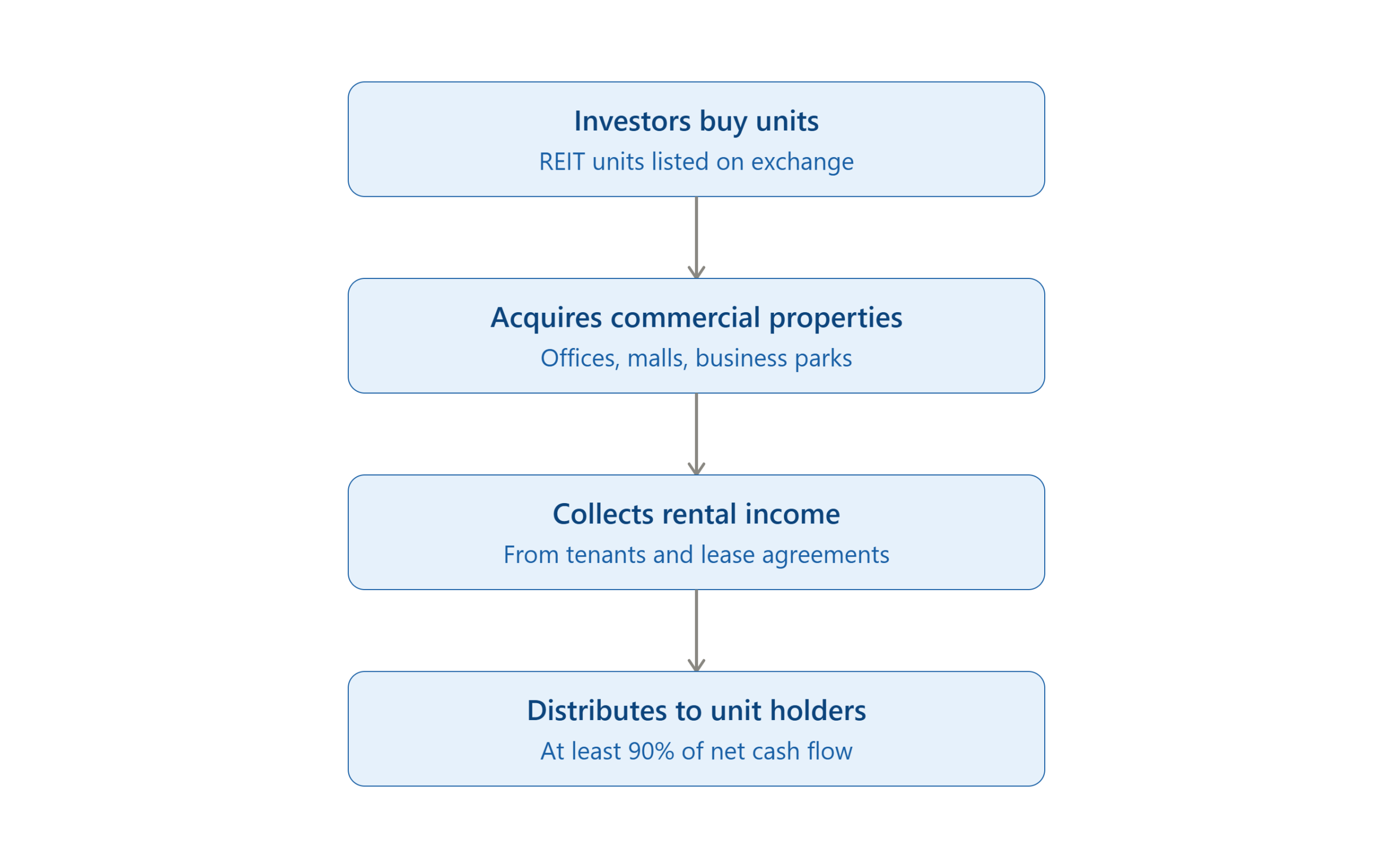
A REIT (Real Estate Investment Trust) owns commercial properties, office buildings, malls, business parks, and pays out most of the rent it collects to whoever holds units in it.
A REIT works more like buying shares of a company: you own units, those units are listed on the stock exchange, and you can buy or sell them any time the market is open. The whole idea is to earn real estate income without the hassle of owning a physical property directly.
How REITs Work?
A REIT owns its properties either directly or through special purpose vehicles (SPVs). How much money actually reaches you depends on the basics such as how many units are rented out, how full the buildings are, and what kind of lease terms the tenants signed. That income then comes back to you as dividends, interest, or capital returns.
Eligibility Criteria for a REIT
For a trust to qualify and operate as a REIT under SEBI’s regulations, it has to meet a fairly detailed set of conditions. These broadly fall into three buckets.
1. Structure and Asset Composition
A REIT has to be set up as a trust under the Indian Trusts Act and registered with SEBI. At least 80% of its asset value must be invested in completed, revenue-generating properties, with only a small portion allowed in under-construction assets. The trust also needs a minimum asset base of ₹500 crore to be eligible for listing.
2. Investor and Ownership Rules
The sponsor setting up the REIT is required to hold a minimum stake in the trust for a set period, which keeps their interests aligned with other investors. REITs also need to maintain a minimum public float and a minimum number of unit holders once listed, so ownership doesn’t stay concentrated in just a few hands.
3. Income Distribution and Reporting
REITs must distribute at least 90% of their net distributable cash flow to unit holders, typically on a quarterly basis. They’re also required to get their properties valued periodically and disclose these valuations, along with regular financial reporting, so investors have visibility into how the underlying assets are actually performing.
What are InvITs?
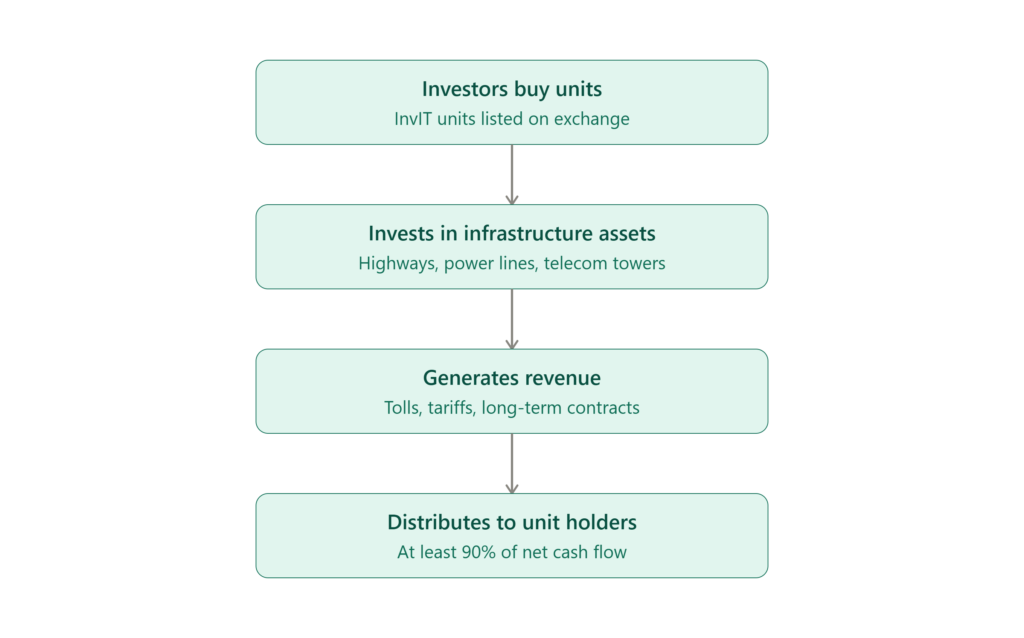
An InvIT, or Infrastructure Investment Trust, follows the same basic idea as a REIT, just with a different set of assets underneath it. Instead of office buildings and malls, it holds things like highways, power transmission lines, renewable energy projects, telecom towers, and gas pipelines.
Like REITs, InvIT units are listed on stock exchanges, which means you can invest with a fraction of what it would take to own an infrastructure asset directly, and exit whenever the market is open.
How InvITs Work
InvITs pool money from investors and deploy it into infrastructure projects that are already operational and generating revenue, either by owning them directly or through SPVs set up for individual projects. The income these assets earn, tolls from highways, transmission charges from power lines, lease rentals from telecom towers, gets passed back to investors.
Eligibility Criteria for InvITs
Just like REITs, InvITs need to satisfy a set of SEBI-defined conditions before they can be set up and listed.
1. Investment Composition
InvITs are required to invest at least 90% of their asset value in completed, revenue-generating infrastructure projects, a slightly higher threshold than what applies to REITs, given that infrastructure assets tend to carry longer gestation periods and more operational complexity.
2. Structure and Governance
An InvIT is built around four key parties: the sponsor who sets up the trust and contributes assets, the trustee who holds these assets on behalf of investors, the investment manager who oversees financial decisions, and the project manager who handles day-to-day operations of the infrastructure itself. Each of these parties has to meet SEBI’s eligibility and net worth requirements.
3. Listing and Transparency
Publicly listed InvITs must meet minimum public unit holding and asset base requirements similar to REITs, and are required to submit regular valuation reports, quarterly financial disclosures, and borrowing details to stock exchanges. This is meant to keep investors informed about how leveraged the trust is and how its assets are performing over time.
What are the Key Differences Between REITs and InvITs
| Parameter | REITs | InvITs |
| Underlying Asset | Commercial real estate (offices, malls, business parks) | Infrastructure (highways, power lines, telecom towers) |
| Income Source | Rental income from tenants | Tolls, tariffs, lease rentals, long-term contracts |
| Minimum Asset Investment | 80% in completed, income-generating properties | 90% in completed, revenue-generating projects |
| Payout Requirement | At least 90% of net distributable cash flow | At least 90% of net distributable cash flow |
| Return Drivers | Occupancy rates, rental escalations, property demand | Contract tenure, usage volumes, regulatory tariffs |
| Volatility | Moderately linked to real estate market cycles | Relatively more stable due to long-term government or corporate contracts |
Which Is Better for Stable Returns: REIT or InvIT?
There isn’t a straightforward winner here, it depends on what kind of stability you’re looking for.
InvITs tend to have an edge when it comes to predictability. Their revenue often comes from long-term contracts with government bodies or large corporations, tolls, fixed transmission tariffs or lease agreements that run for years. This makes their cash flows relatively less sensitive to short-term market swings compared to real estate.
REITs are still fairly stable but their income depends more on occupancy levels and rental cycles, which can be influenced by broader economic conditions, business sentiment and demand for commercial space. In a strong economic cycle, this can actually work in a REIT’s favour, since rentals and property values tend to rise. In a slowdown, it can be more of a headwind.
If your priority is the steadiest possible income stream with lower correlation to market cycles, InvITs generally fit that need a little better. If you’re comfortable with slightly more variability in exchange for potential upside tied to real estate demand, REITs are worth considering too. Many investors choose to hold both, since they offer exposure to two very different parts of the economy while keeping the same basic trust structure and payout discipline.
Conclusion
Both REITs and InvITs allow access to asset classes which were not available to retail investors earlier and offer the advantages of listed liquidity and dividend pay-out policies. The choice between the two will depend upon the amount of stability and exposure one desires, and there is a strong case to include both types in an investor’s portfolio.
As with any market-linked investment, it’s worth spending time understanding the specific trust, its assets, and its track record before committing money, rather than relying on the structure alone.
Disclaimer: This article is for informational purposes only and does not constitute investment advice. Investments in securities are subject to market risks. Investors should consult a registered financial advisor before making any investment decisions.