

FCNR deposits have quietly become one of the more important tools Indian banks use to manage their dollar books. Right now, they are working well. NRIs get attractive dollar returns, and banks get a steady source of foreign currency funding. But underneath this arrangement sits a structure that behaves exactly like a leveraged currency trade, and such setups carry risk that only shows up when conditions turn.
This article looks at how FCNR deposits work, why oil prices sit at the center of the risk, and what could happen to India’s banking system if the rupee weakens meaningfully over the next five years.
India Has Been a Carry Recipient for Years
For a long stretch, foreign money has flowed into India in search of higher returns. This showed up across:
- Equities
- Bonds
- Rupee-denominated assets
- Real estate and other domestic asset classes

This inflow is itself a form of carry trade. Global investors borrow cheap capital elsewhere and deploy it in India, where returns have historically been higher. Global carry conditions are gradually shifting, and foreign capital has begun to leave India in certain segments. This matters because FCNR deposits have effectively stepped in to replace some of that outgoing foreign capital, only this time in the form of debt rather than equity or portfolio investment.
How FCNR Deposits Work as a Carry Trade
The mechanics are straightforward once broken down step by step:
- An NRI gives dollars to an Indian bank
- The bank promises to return those dollars, plus interest, at maturity
- The bank converts or swaps those dollars into rupees
- The bank deploys that rupee liquidity in India, where returns are higher
- The spread between what the bank pays on dollars and what it earns in India is the carry trade
In simple words, India is replacing outgoing foreign portfolio capital with foreign-currency debt. This can work well when currency markets are calm and the rupee holds steady. Explore how different equity themes are positioned relative to currency-sensitive sectors on TejiFactor for a broader view of how these flows show up across the market.
The Oil-to-Rupee Transmission Mechanism
The biggest risk to this arrangement traces back to something that has little to do with banking on the surface: ‘Oil’.
- Oil prices staying elevated for months raises India’s import bill
- A bigger import bill increases demand for dollars
- Higher dollar demand puts pressure on the rupee
- Sustained pressure weakens the rupee over time
India imports the bulk of its crude requirement, so this transmission mechanism is not new. What makes it relevant here is how it interacts with FCNR obligations sitting on bank balance sheets.
Why This Becomes Dangerous: The Chain Reaction
FCNR depositors want their dollars back regardless of how the rupee has moved in between. That commitment does not change just because the currency has weakened. The danger builds when several pressures line up at the same time:
- Oil prices rise
- India needs more dollars to cover its import bill
- Foreign investors keep pulling money out
- The rupee weakens under this combined pressure
- Banks still owe the same dollar amount on their FCNR deposits
- Banks need many more rupees to buy back those dollars
- Repayment becomes costlier for the bank
- The RBI may need to step into the market to manage the pressure
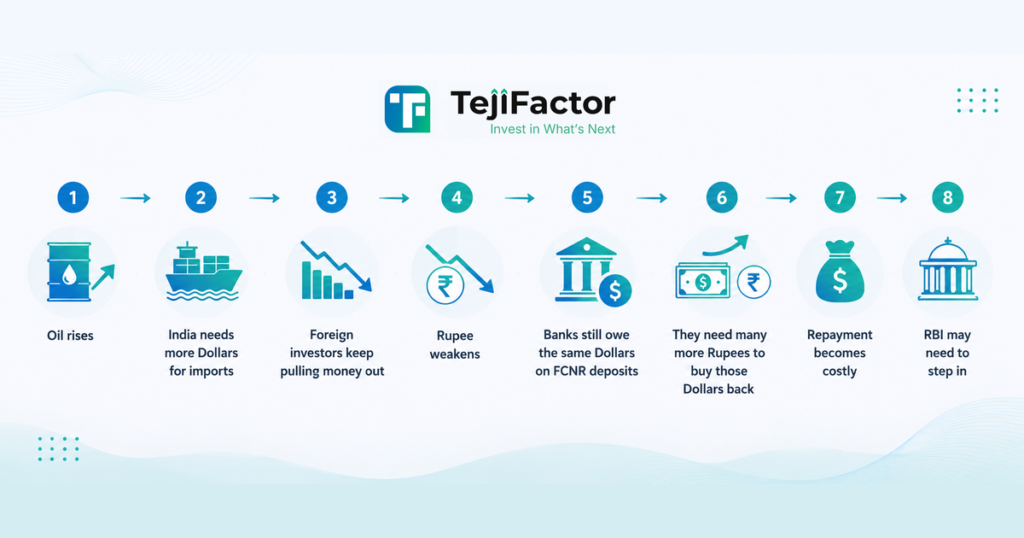
Each of these steps is manageable on its own. The real problem shows up when they collide at the same time. That is the point at which a genuine dollar crunch can form, and it is also the point at which central bank intervention becomes likely.
The Sovereign Gold Bond Parallel
India has run a version of this playbook before, through Sovereign Gold Bonds.
- The government issued SGBs without backing them with physical gold
- Gold prices roughly tripled over six years
- The government ended up sitting on a large unfunded liability, reportedly over ₹1.2 lakh crore
Leveraged FCNR deposits follow a similar structure in a new form. Banks are currently offering NRIs yields of up to 16% per annum in dollar terms, again without any actual dollar reserve backing that commitment. The obligation exists on paper, funded by future rupee earnings rather than by reserves set aside today.
The question this raises is simple. What happens if the rupee weakens meaningfully over the next five years? The larger this scheme grows, the larger the exposure becomes for the banks running it.
Who Bears the Risk
For the depositor, the arrangement is simple. They want their dollars back and the exchange rate at the time of deposit is not their concern.
The bank carries the entire currency and repayment risk in this trade. It borrowed dollars, converted them into rupees and deployed those funds domestically. If the rupee weakens by the time repayment is due, the bank needs more rupees to buy back the same amount of dollars it originally borrowed. That gap comes straight out of the bank’s own books.
Conclusion
FCNR deposits can buy time for Indian banks in the short run. They provide a steady, predictable source of dollar funding at a moment when other foreign capital sources are less reliable. But replacing lost foreign capital with dollar-denominated debt carries its own risks, particularly those tied to oil prices and rupee movements over a multi-year horizon.
For the depositor, it is simple. They just want their dollars back. But the risk of that entire trade rests with the bank, and if conditions change, that risk does not remain contained. It reaches the wider financial system.
Disclaimer: This article is for informational and educational purposes only and does not constitute investment advice. TejiFactor is a SEBI-registered platform and readers are advised to conduct their own research or consult a registered investment advisor before making any financial decisions. Past trends or comparisons referenced in this article do not guarantee future outcomes.