

Quick Summary
If equities make up the larger share of your portfolio, bonds are usually what balance out the rest. They provide investors with a means to earn a steady income while maintaining overall volatility in check. The concept itself is simple but with limited resources, explaining it clearly, it is easy to feel unsure where to start. This article covers what bonds are, how they work, the different types available and what to keep in mind before investing in one.
What is a Bond?
A bond is like a loan you give to a company, government or organization which helps them raise money for important projects and keep the cash flow going. When you buy a bond, the issuer promises to pay you back the full amount you lent (the principal) on a specific date, called the maturity date. On top of the principal amount, you get regular interest, known as coupons, at a set rate during the life of the bond. It’s a simple way to earn steady returns while helping fund various projects or initiatives.
Who issues bonds?
Various entities issue bonds to raise funds for large-scale projects or operations:
- Governments: to fund infrastructure, public services or manage fiscal deficits
- Public Sector Undertakings (PSUs): for development projects or operational needs
- Corporations: to expand businesses, finance new ventures or fund working capital requirements
- Municipalities: to develop urban infrastructure
Understanding the Bond Market
The bond market, also known as the fixed-income market is where bonds are bought and sold. It enables issuers to raise funds while providing investors with a stable income source. This market plays a crucial role in funding projects, maintaining the financial system’s stability and fostering economic growth.
Types of Bonds
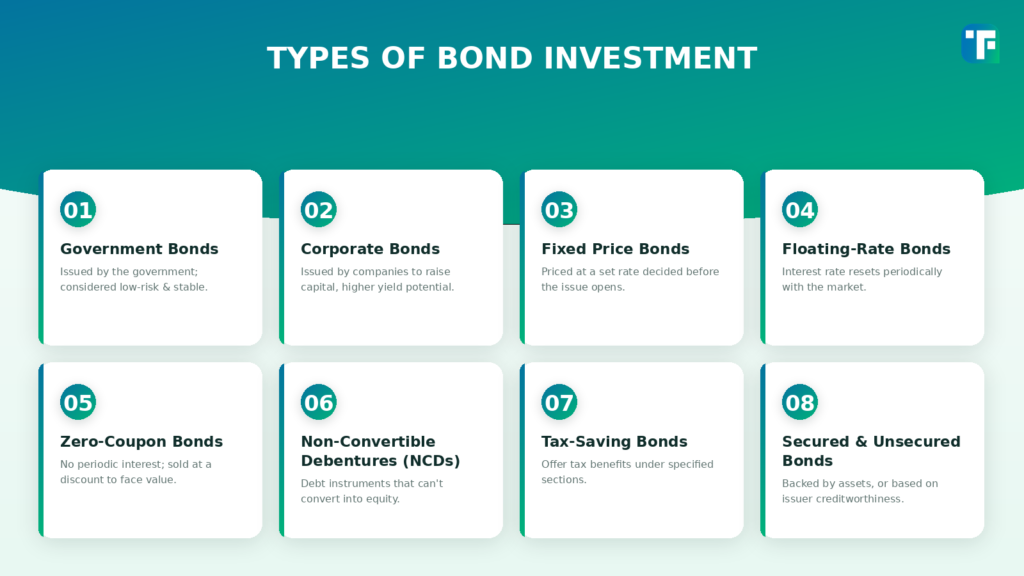
Bonds are broadly categorised as listed and unlisted and are regulated by SEBI. Listed bonds are traded on stock exchanges such as the BSE and NSE, making them easier to buy and sell. Private organisations typically issue unlisted bonds and are not traded on exchanges, making them less accessible but potentially offering different investment opportunities.
- Government Bonds: Central or state governments issue these bonds to fund public spending, infrastructure projects, and development activities. These bonds usually have longer tenures and are considered safer as the government backs them.
- Corporate Bonds: Companies issue these bonds to raise funds for expansion, operations, or refinancing existing debt. These bonds offer better returns than government bonds, but the risk level increases with the issuer’s financial strength.
- Fix Price Bonds: The interest rate on these bonds is fixed till the time of maturity. Therefore, it becomes easy for the investor to estimate the income generated from the investment.
- Floating-Rate Bonds: Such bonds have an interest rate that changes periodically based on the interest rates or a benchmark rate. It means the interest payment may fluctuate (increase or decrease) depending on trading ecosystem conditions.
- Zero-Coupon Bonds: The investor does not get interest every year. Instead, it is bought at a lower price and repaid at the higher value later.
- Non-Convertible Debentures (NCDs): These are a type of bond that pays interest and returns the money later, but they cannot become company shares.
- Tax-Saving Bonds: Some bonds are issued with tax benefits under specific regulations. These bonds are usually meant for long-term investments and may have lock-in periods.
- Secured and Unsecured Bonds: Secured bonds are backed by company assets, in case the company fails to repay the amount to the issuer. Unsecured bonds are not backed by any assets and rely mainly on the company’s financial strength.
How Do Bonds Work?
Bonds are loans made by investors to the issuer. In return, the issuer pays regular interest (coupon payments) and returns the principal (face value) at maturity. Bonds have a fixed term and a set interest rate.
The lifecycle of a bond can be summarised in three stages:
1. Issuance: Bonds are created and sold by issuers to raise capital. Key terms such as the interest rate, maturity date and face value are detailed in the bond documentation. Once issued, the bond is sold to investors in the primary market, either directly or through underwriting.
2. Holding Period: After investing in a bond, investors earn regular interest payments from the issuer until maturity. Listed bonds can also be bought and sold between investors in the secondary market during this period.
3. Maturity or Redemption: On maturity, the issuer repays the full face value of the bond to the bondholder. If the bond is callable, the issuer may choose to redeem it earlier, typically when interest rates fall and refinancing at a lower cost becomes attractive.
Features of Bonds
Bonds can serve different financial goals, from steady income to capital preservation, making them a common component of diversified portfolios.
- Face Value (Par Value): The amount the bondholder receives at maturity, also used to calculate interest payments.
- Coupon Rate: The interest the issuer pays to the bondholder, usually expressed as a percentage of face value. Payments may be annual, semi-annual, or quarterly.
- Maturity Date: The date on which the face value is repaid. Bonds may be short-term (under 1 year), medium-term (1-10 years), or long-term (over 10 years).
- Issuer: The entity issuing the bond. The issuer’s creditworthiness affects the bond’s risk level.
- Yield: the return earned on a bond, factoring in its current market price, coupon rate and time to maturity.
- Credit Rating: Assigned by rating agencies based on the issuer’s creditworthiness.
- Market Price: The price at which a bond trades in the secondary market, which moves with interest rates and issuer credit quality.
- Callability: Whether the issuer has the option to repay the bond before maturity.
Bond Ratings and What They Mean
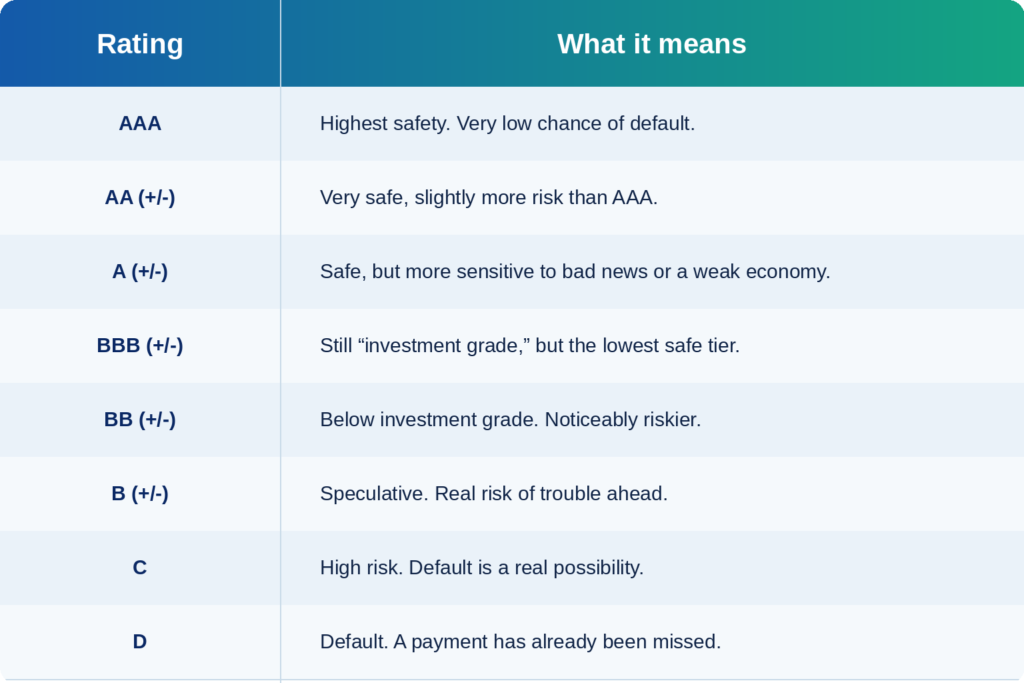
Bond ratings assess the creditworthiness of the issuer and the likelihood of timely repayment of interest and principal. They are assigned by credit rating agencies such as CRISIL, ICRA and CARE, with ratings ranging from high grade (AAA) to speculative grade (BB or lower).
Advantages of Investing in Bonds
- Diversification: Bonds help balance a portfolio, particularly for investors with a lower risk appetite.
- Lower Risk: Bonds are generally considered less risky than equities and many are backed by some form of security.
- Regular Income: Bonds provide a fixed stream of income through periodic interest payments.
- Predictable Returns: Coupon payments are set at the time of purchase and continue until maturity, making it easier to plan around expected income.
- Capital Preservation: Government and investment-grade corporate bonds are generally considered low-risk options for preserving capital.
Risks in Bond Investing
- Interest Rate Risk: Bond prices tend to decline when interest rates rise, which can affect market value.
- Credit Risk: The possibility that the issuer may default on interest payments or principal repayment, particularly relevant for lower-rated corporate bonds.
- Inflation Risk: Fixed interest payments can lose purchasing power during periods of high inflation.
- Liquidity Risk: Some bonds, especially unlisted or thinly traded ones, can be difficult to sell quickly without affecting the price.
How to Invest in Bonds
When an issuer raises funds for the first time, it does so through the primary market. Bonds that have already been issued can be bought or sold in the secondary market.
Common routes for retail investors:
- RBI Retail Direct: Allows investors to buy government securities directly by opening a Retail Direct Gilt Account with the RBI, covering instruments such as Treasury Bills and government bonds.
- Brokerage Platforms: Brokers provide access to listed bonds, including PSU and corporate bond issues.
- Online Bond Platforms: SEBI-regulated online platforms allow investors to access government securities and corporate bonds, often with lower minimum investment amounts, along with offer documents and rating details.
- Stock Exchanges (NSE and BSE): Listed bonds can be bought and sold through a regular demat and trading account.
Who Should Invest in Bonds
Bonds may suit:
- Conservative investors who prioritise safety over high returns
- Income seekers looking for regular, stable interest payments
- Risk-averse investors who prefer less volatility compared to equities
- Retirees or near-retirees seeking capital preservation and steady income
- Diversifiers looking to balance a stock-heavy portfolio
- Long-term investors focused on preserving capital with steady returns over time
Bonds vs Other Investments
Bonds vs Equities: Bonds are loans to an entity with fixed returns. Equities represent ownership in a company, offering potential for growth but with higher risk.
Bonds vs Debentures: Bonds are typically secured debt, while debentures are unsecured and rely on the issuer’s creditworthiness rather than collateral.
Bonds vs Fixed Deposits. Bonds can be traded before maturity and may offer different return profiles. Fixed deposits are bank deposits with fixed returns but less flexibility.
Bonds vs Mutual Funds: Bonds provide a fixed, direct income stream. Debt mutual funds offer diversification across multiple bonds but with returns that can vary.
Conclusion
Bonds are widely considered a lower-risk avenue compared to equity investments, offering the ability to preserve capital while generating regular income. In the event an issuer is unable to meet its obligations, bondholders, as creditors, generally rank ahead of equity shareholders in terms of repayment priority. For investors seeking to diversify their portfolios with a steadier income stream, understanding bonds in detail is worthwhile.