

Quick Summary
If you have ever heard someone mention an AIF and wondered what it actually means, this article breaks it down in plain terms. You will learn who is eligible to invest, why AIFs demand a ₹1 crore entry ticket, how SEBI splits them into three categories, how each category is taxed differently, and why knowing the category matters more than the AIF label itself.
What Are Alternative Investment Funds (AIFs)
An AIF is a SEBI-regulated investment vehicle that pools money from investors and deploys it into asset classes such as private equity, venture capital, real estate and hedge fund-style strategies, instead of the usual stocks or mutual fund route. The industry has grown to nearly 1,800 registered AIFs in India with total commitments crossing ₹15 lakh crore.
Who Can Invest in AIFs?
- Alternative Investment Funds have defined eligibility conditions. Indian residents, Non Resident Indians, and foreign nationals can invest.
- Joint applications are allowed with a spouse, parents or children.
- The minimum investment amount is Rs. 1 crore for most investors and Rs.25 lakh for fund managers, directors or employees of the AIF.
- Generally, AIFs have a minimum lock-in period of three years.
- Each AIF scheme can have up to 1,000 investors, while angel funds are restricted to a maximum of 49 investors.
SEBI’s Three-Category Framework
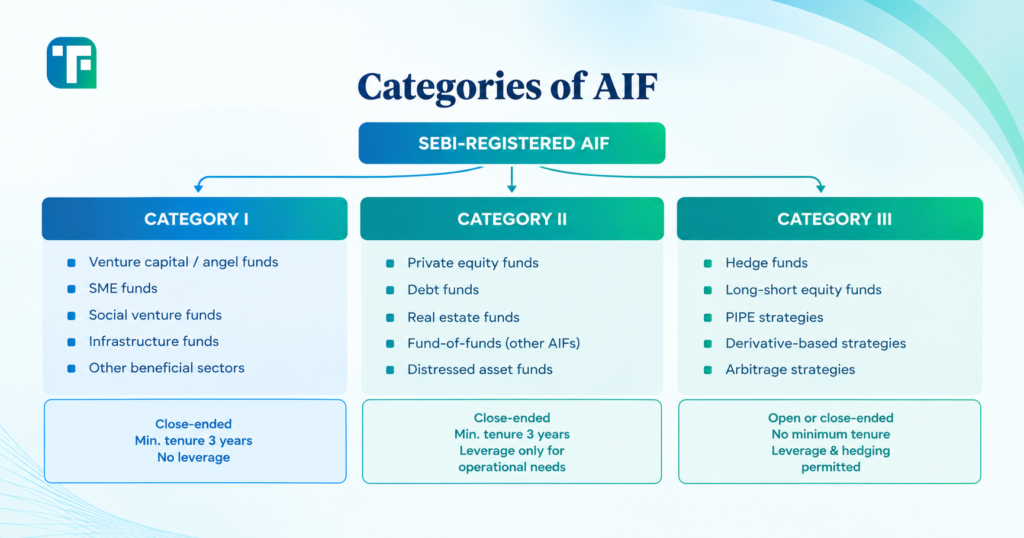
SEBI does not regulate all AIFs the same way. It splits them into three categories and the category a fund falls into says a lot about what it actually does with investor money.
Category I
Category I funds aim to support economic and social progress. They invest in areas like startups, small businesses, infrastructure development and projects that generate employment. This category is government-encouraged, meaning it often comes with tax incentives because the underlying investments feed into sectors the government wants to support.
Types of Category I AIFs:
- Venture Capital Funds (VCFs): These funds invest in newly established companies that show strong potential for rapid growth.
- SME Funds: These funds provide financial resources to small and medium sized businesses to help them scale up their operations.
- Social Venture Funds: These funds target enterprises working toward social or environmental benefits, such as projects promoting renewable energy and sustainability.
- Infrastructure Funds: These funds finance the construction and development of essential infrastructure, including roads, railways, airports, and urban modernization initiatives.
Category II
Category II is the broadest bucket. It covers companies with an established presence that need additional capital to expand, typically financed through private equity or debt in companies that are not publicly traded. These funds do not get special incentives and they are not permitted to use extra leverage beyond what is needed for day-to-day operations. Most AIF money in India sits in this category.
Types of Category II AIFs:
- Private Equity Funds: These funds provide capital to private companies to support their growth before they go public.
- Debt Funds: These funds invest in debt instruments issued by unlisted companies, which may carry higher risk due to lower credit ratings.
- Fund of Funds: These funds allocate capital across a variety of other AIFs to diversify investment risk.
Category III
Category III is the aggressive end of the spectrum. These funds follow strategies targeting short-term profits, using methods such as active trading, leverage and complex instruments like derivatives. This is the only category built for active trading rather than long-term capital deployment, which also makes it the category with the highest risk and the most complex return profile.
Types of Category III AIFs:
- Hedge Funds: These funds employ strategies such as short selling, arbitrage, and margin trading to pursue higher returns, often involving greater risk.
- Private Investment in Public Equity (PIPE) Funds: These funds invest in publicly traded companies by buying shares at a discount, typically when the company needs additional capital.
The specific category tells you far more about a fund’s actual risk and return profile than any general pitch about “alternative investments”.
Taxation Differences Across Categories
The category also decides how gains are taxed, and this is where many first-time AIF investors get caught off guard.
- Category I and Category II funds use a pass-through structure. This means the fund itself does not pay tax on the income it earns. That income flows directly to investors, who then report it and pay tax individually.
- In Category III funds, taxation usually happens at the fund level itself. The fund pays tax on its income before any distribution reaches the investor, which changes the effective return an investor takes home compared to a pass-through structure.
This is not a minor technical detail. It changes the actual math of what an investor earns after tax, and it is one of the clearest ways the three categories diverge from each other even when the headline return numbers look similar.
Why the Category Distinction Matters
AIFs are often discussed as if they were a single product but that is misleading. Each category represents a different risk universe. A Category I venture capital fund backing early-stage startups carries a completely different risk and return profile than a Category III fund running leveraged derivative strategies, even though both are technically registered as AIFs under the same SEBI framework.
The category is what determines the real risk and tax profile of that investment. Two investors can both say they are in an AIF and face entirely different outcomes depending on whether they sit in Category I, II, or III.
This is also why anyone evaluating an AIF opportunity should always ask which category the fund falls under before looking at anything else, including projected returns or the track record of the fund manager. If you are trying to build a broader picture of how HNI-oriented instruments compare with more accessible listed alternatives such as REITs and InvITs, TejiFactor’s comparison of REITs and InvITs is a useful next read for understanding how India’s other pooled investment structures stack up.
Conclusion
Alternative Investment Funds in India are emerging as a powerful avenue for sophisticated investors seeking diversification, higher return potential, and access to exclusive market opportunities. While they demand a larger initial commitment and carry certain risks, their professionally managed strategies and focus on non-traditional assets make them an attractive option for those with the appetite for long-term, high value investments. With increasing investor interest and evolving regulatory support, the AIF market in India is poised for substantial expansion in the years ahead.
Investments in Alternative Investment Funds are subject to market risks. This article is for informational purposes only and should not be construed as investment advice. Please consult a SEBI-registered investment advisor before making any investment decisions.